Hidden Corners of Ålesund: Where Art Nouveau Meets Quiet Charm
Have you ever wandered a city and felt like you stumbled into a secret world? That’s exactly what happened in Ålesund, Norway. Beyond its famous skyline of spires and fjord views, I discovered quiet neighborhoods alive with color, history, and local soul. This isn’t just a postcard town—it’s a living, breathing story waiting in its side streets. Nestled along Norway’s rugged west coast, Ålesund rises from the sea like a painted dream, its pastel Art Nouveau buildings glowing in the soft northern light. But beyond the postcard-perfect panoramas lies a quieter, deeper truth: the real heart of this town beats in its residential lanes, its unmarked cafés, and the daily rhythms of those who call it home. This is a journey not through monuments, but through moments.
The First Glimpse: A Town Reborn from Fire
Ålesund’s story begins not with beauty, but with tragedy. In January 1904, a fire swept through the wooden town, consuming nearly 800 homes and leaving over 10,000 people homeless. The devastation was immense, but the response was extraordinary. With support from the Norwegian royal family and architects trained in Germany and Denmark, the town was rebuilt almost entirely in the Art Nouveau style—then at the height of European fashion. What emerged was not a replica of what had been lost, but something entirely new: a seaside city of turrets, gables, and ornate stonework, painted in soft blues, pinks, and creams that reflected the surrounding sea and sky.
This architectural rebirth was more than aesthetic—it was an act of collective resilience. Every carved dragon motif, every spiraling tower, carries the spirit of a community that chose beauty in the face of ruin. Today, walking through the city center, one cannot help but feel the weight of that history. The buildings are not merely decorative; they are memorials to renewal. Yet, while the main squares like Apotekertorget draw crowds for their photogenic facades, the deeper layers of Ålesund’s character lie beyond these postcard views. To understand the town’s soul, one must move past the central plazas and into the quieter streets where history lives not in plaques, but in the rhythm of everyday life.
These lesser-known lanes, often overlooked by guidebooks, offer a more intimate conversation with the past. Here, the Art Nouveau details are not curated for tourists but are part of a living townscape—windowsills still crowned with intricate ironwork, doors framed by floral stonework, rooftops dotted with whimsical spires. The town’s rebirth was not just architectural; it was cultural. Families rebuilt homes, shopkeepers reopened businesses, and children grew up among these fairy-tale buildings. To walk these streets is to witness not a museum piece, but a community that has carried its history forward with quiet pride.
Walking the Whispering Streets of Borgundvegen
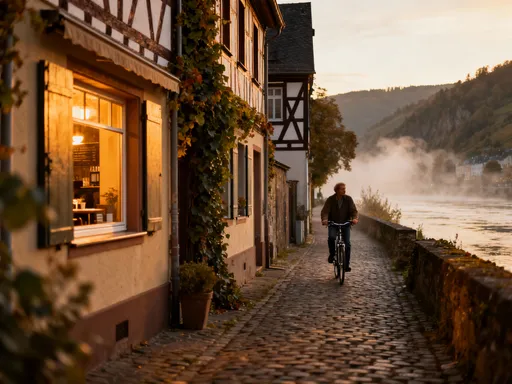
One of the most evocative streets in Ålesund is Borgundvegen, a gently sloping lane that winds through a residential neighborhood just uphill from the harbor. Here, the city’s Art Nouveau heritage is not on display—it is lived in. Rows of pastel-colored homes with steep roofs and elaborate gables line the street, their facades adorned with flowing lines, floral motifs, and mythological figures carved in stone. Morning light spills over the rooftops, casting long shadows across the cobblestones and illuminating the delicate textures of weathered brick and painted wood. The air is still, broken only by the distant cry of gulls or the soft chime of a church bell from nearby Jugendstilsenteret.
What makes Borgundvegen so compelling is not just its beauty, but its silence. Unlike the bustling waterfront, where tour groups gather for panoramic photos, this street feels suspended in time. There are no souvenir shops, no loudspeakers, no crowds. Instead, there are flower boxes bursting with geraniums, bicycles leaning against garden gates, and the occasional cat sunning itself on a windowsill. It is a place where one can pause and simply listen—to the wind in the trees, to the rustle of leaves underfoot, to the quiet hum of a town waking up.
The architectural details here speak of craftsmanship and care. Each home is unique, yet they form a harmonious ensemble, like verses in a poem. One house might feature a lion’s head above the doorway, symbolizing strength; another, a mermaid carved into the eaves, nodding to the town’s maritime roots. These are not random decorations but deliberate expressions of identity and hope. In the early 1900s, as the town rose from ashes, architects and builders infused their work with symbolism—reminders of resilience, nature, and the enduring human spirit. To walk Borgundvegen is to walk through a gallery of quiet optimism, where beauty is not a luxury but a necessity.
Discovering Local Life in Sykkylvenbakken
Just a short climb from the city center lies Sykkylvenbakken, a residential slope that offers both panoramic views and a glimpse into the daily life of Ålesund’s residents. This neighborhood is not designed for tourists; it is lived in, worn in, and deeply rooted in routine. Houses here are more modest than those in the central Art Nouveau district, often painted in earthy tones or left in natural wood. Gardens are small but lovingly tended, with rows of tulips in spring and herbs growing in repurposed crates. Clothes hang on lines between houses, gently swaying in the coastal breeze, and children’s toys sit on porches, waiting for the next game.
What stands out in Sykkylvenbakken is the sense of normalcy. Neighbors greet each other by name, dogs bark playfully from fenced yards, and the occasional bicycle bell rings as someone pedals home with groceries. There is no performative charm here—no staged photo opportunities or curated experiences. Instead, there is authenticity: a woman watering her window boxes, an elderly man reading the newspaper on his porch, a couple walking hand in hand down the narrow sidewalk. These are the unscripted moments that define a place, the ones that never make it into brochures but are essential to understanding its soul.
The views from this slope are breathtaking—fjords stretching into the horizon, islands scattered like stones across the water, and the city unfolding below like a patchwork quilt of rooftops and spires. Yet, the real beauty lies not in the vista, but in the contrast between the grandeur of nature and the simplicity of human life. While tourists flock to the official viewpoints like Aksla Tower, locals here enjoy the same scenery without fanfare, as part of their everyday reality. It is a reminder that beauty is not always something to be sought; sometimes, it is simply lived within.
Accessibility to Sykkylvenbakken is easy on foot, though the climb can be steep for some. There are no marked trails or visitor signs, which adds to its quiet appeal. For travelers, visiting such a neighborhood requires a certain respect—this is not a theme park, but a home. The best approach is to walk quietly, keep to the sidewalks, and observe without intruding. A smile, a nod, a quiet ‘god dag’ (good day) in passing can go a long way in honoring the space and the people who live there.
Fjellstua and the Joy of Getting Lost
Near the Fjellstua viewpoint, a network of narrow footpaths winds through the hillside, connecting homes, gardens, and hidden clearings. This area is not mapped in most tourist guides, and there are no information boards or directional signs. That is precisely its magic. To walk here is to embrace uncertainty, to allow oneself to get gently lost. There are no grand attractions—just a series of small discoveries: a wooden bench facing the sea, a wild rose blooming in a stone wall, a child’s chalk drawing on a driveway. These moments are fleeting, unplanned, and deeply human.
One afternoon, I turned down a path I hadn’t noticed before, following the sound of rustling leaves. It led to a small garden enclosed by a low stone wall, where a woman was pruning hydrangeas. She smiled and gestured toward the view—a perfect frame of the fjord between two pine trees. No words were exchanged, but the invitation was clear. Such encounters are rare in heavily touristed areas, where interactions are often transactional. Here, in the quiet corners of Ålesund, there is space for spontaneous connection, for the kind of silent understanding that transcends language.
The terrain in this area can be uneven, with moss-covered steps and loose gravel, so sturdy footwear is recommended. Mornings and late afternoons offer the best light and the fewest people, making them ideal for exploration. There is a meditative quality to walking without a destination—each turn reveals something new, each pause allows for reflection. It is in these unplanned moments that travel becomes transformative. The act of wandering becomes a form of listening, a way of tuning into the subtle rhythms of a place.
Getting lost, in this context, is not a mistake but a method. It forces a slower pace, a heightened awareness. One begins to notice details that might otherwise go unseen: the way sunlight filters through birch leaves, the scent of damp earth after rain, the distant hum of a fishing boat engine. These sensory impressions accumulate, forming a deeper, more personal connection to the place. In a world where travel is often reduced to checklists and photo ops, the joy of getting lost is a quiet rebellion—a return to curiosity, to wonder, to presence.
The Pulse of the Harbor: A Different Kind of Quiet
While much of Ålesund’s tourism focuses on its scenic beauty, the working harbor remains the town’s quiet heartbeat. This is not the polished marina where yachts dock for the summer season, but the functional waterfront where fishing boats return with the day’s catch. The air here carries the sharp scent of salt and seaweed, mingled with the faint tang of diesel. Nets hang over rails to dry, buoys bob in the water, and gulls circle overhead, waiting for scraps. Men in waterproof jackets move with purpose, unloading crates, checking gear, exchanging brief words in Norwegian.
There is a rhythm to this place—a steady, unshowy pulse that speaks of continuity. These boats are not for show; they are tools of livelihood. Many belong to families who have fished these waters for generations, their lives shaped by tides and seasons. The harbor is not picturesque in the conventional sense—there are rust stains on the docks, frayed ropes, and weathered signs—but it is honest. It does not perform for visitors; it simply exists, carrying on the work that has sustained Ålesund for centuries.
For travelers, spending time in this part of town offers a different kind of experience—one rooted in reality rather than romance. It is possible to walk along the working piers (where permitted), observing the quiet industry without disrupting it. Some local restaurants source their seafood directly from these boats, offering meals that connect the diner to the sea in a tangible way. A plate of fresh cod or shrimp is not just a meal; it is a story of labor, weather, and tradition.
This quieter harbor also serves as a reminder that tourism is only one layer of a destination. Behind the postcard views are communities that live and work year-round, unaffected by the seasonal ebb and flow of visitors. To acknowledge this, to honor it, is to travel with greater awareness. The beauty of Ålesund is not just in its architecture or scenery, but in the way it balances its dual identities—as a destination for travelers and a home for locals.
Cafés and Corners: Where Locals Pause
Scattered throughout Ålesund’s residential areas are small, unassuming cafés and bakeries that serve as quiet gathering spots for locals. These are not the Instagram-famous coffee shops in the city center, but neighborhood institutions—places with chipped mugs, mismatched chairs, and the warm scent of cinnamon and cardamom in the air. One such spot, tucked into a corner of a quiet street, offers kanelboller (cinnamon buns) still warm from the oven and strong black coffee served in thick ceramic cups. There are no menus on digital screens, no baristas wearing aprons with logos—just a woman behind the counter who knows her regulars by name.
These micro-spaces are essential to the social fabric of the town. They are where mothers meet after dropping off children at school, where retirees read the newspaper with a midday cup, where friends catch up over slices of homemade cake. The conversations are low, the laughter soft. There is no rush, no pressure to turn over tables. Time moves differently here—slower, more intentional. For a visitor, sitting in such a café is not just about the coffee; it is about participation in a quiet ritual, about being present in a space that values stillness.
Engaging with these places requires a gentle approach. It is not about taking photos or claiming the ‘best’ seat, but about respect—ordering something, sitting quietly, perhaps offering a simple ‘takk’ (thank you) when leaving. These cafés are not performances; they are real. To treat them as such is to preserve their essence. In doing so, the visitor is not just observing local life, but briefly becoming part of it.
Such spaces are often found by accident—down a side street, around a bend, behind a row of blooming rhododendrons. They are not advertised, not rated on travel apps. Their value lies in their obscurity, in the fact that they exist for the community, not for consumption. To discover one is to be rewarded not with a souvenir, but with a feeling—a sense of having touched something true.
Why These Streets Matter: The Soul of a Town
The deeper one ventures into Ålesund’s lesser-known neighborhoods, the more it becomes clear that a city’s identity is not defined by its landmarks, but by its in-between spaces. The grandeur of Art Nouveau architecture is undeniable, but it is the quiet streets, the working harbor, the neighborhood cafés that give the town its soul. These are the places where memory and daily life intersect, where history is not displayed behind glass but lived in the routines of ordinary people.
Travel that focuses only on sights risks reducing a destination to a series of snapshots. But travel that embraces the quiet, the mundane, the unmarked—this is travel that transforms. It asks us to slow down, to observe, to listen. It invites us to see not just what a place looks like, but how it feels. In Ålesund, this means noticing the way light falls on a cobblestone street at dusk, the sound of a door closing in a narrow alley, the warmth of a smile from a stranger in a small bakery.
These experiences are not grand, but they are profound. They remind us that beauty is not always loud or dramatic—it can be found in stillness, in simplicity, in the ordinary. And in a world that often values speed and spectacle, such moments are a gift. They teach us to be present, to appreciate the subtle textures of a place, to travel not as consumers, but as witnesses.
Ålesund’s story is one of resilience, of rebirth, of quiet dignity. But it is also a model for how we might travel—with curiosity, with respect, with openness to the unexpected. The most meaningful journeys are not those that follow a map, but those that allow for detours, for pauses, for the kind of serendipity that happens when we stop looking for something and simply let a place reveal itself.
Carrying the Quiet With You
Leaving Ålesund, I did not carry souvenirs or photos as my most treasured mementos. Instead, I carried the feeling of quiet mornings on Borgundvegen, the scent of cinnamon in a hidden café, the view from a weathered bench that no tour bus would ever reach. These are the moments that linger—not because they were extraordinary, but because they were real.
The true magic of Ålesund lies not in its skyline, but in its stillness. It is a town that speaks softly, that reveals itself slowly, that rewards patience. And in that, it offers a lesson for all travelers: that the deepest connections are not made in crowded attractions, but in the spaces between—the quiet corners, the unspoken gestures, the moments of simply being.
So as you plan your next journey, consider not just where you will go, but how you will be there. Seek not only the famous sights, but the side streets, the local rhythms, the unmarked doors. Travel not to collect experiences, but to cultivate presence. Because sometimes, the most powerful beauty is the kind that doesn’t announce itself—it simply waits, quietly, for those willing to listen.